
Towing Services Malta: Coverage Areas and Response Times
When your car stops in the wrong place at the wrong time, the two things you care about most are simple: will someone come to my location, and how long will it take.
In Malta and Gozo, those questions matter even more because traffic can change quickly, roadworks are common, and some routes (especially to and from Gozo) depend on ferry logistics. This guide explains what “island-wide” towing coverage typically includes, what response time claims like “15–30 minutes” usually mean in real life, and how to help a towing operator reach you faster.
What “towing services Malta” coverage usually includes
A towing and roadside assistance provider with island-wide coverage should be able to dispatch help across:
Malta (all localities): from busy harbour areas to rural roads.
Gozo: with the practical reality that some jobs involve coordination around the ferry crossing.
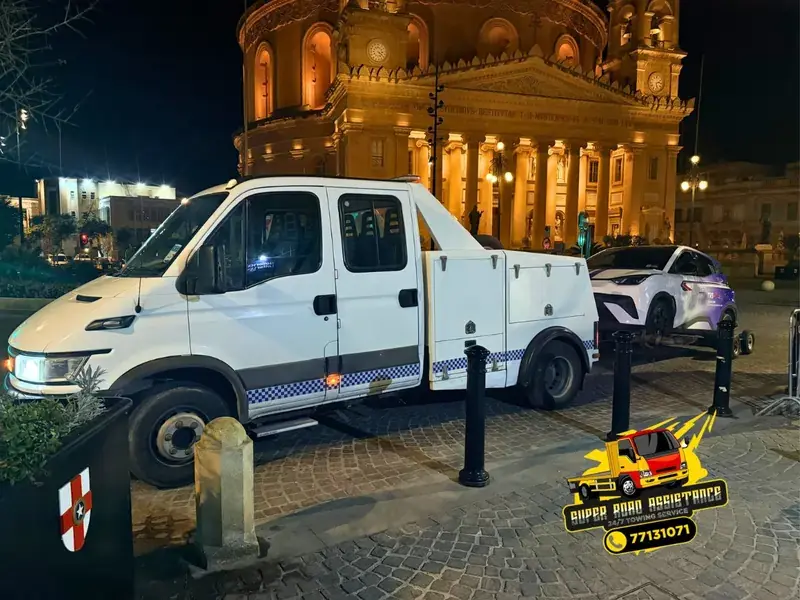
Super Road Assistance provides 24/7 towing and roadside assistance across Malta and Gozo, with an average arrival of 15–30 minutes and immediate dispatch of the nearest unit (no membership required).

Malta coverage areas: what that means in practice
People often search “towing services Malta” while stranded and trying to confirm whether help reaches their exact area. In practice, coverage is less about a strict list and more about whether a nearby unit can access your road safely and quickly.
Here are the main zones most towing operators regularly serve, with example localities (not an exhaustive list):
Malta zone | Common localities (examples) | Typical call-outs |
Northern Harbour | Sliema, St Julian’s, Gżira, Msida, Pembroke, Swieqi | Battery issues, tyre problems, tight parking areas, heavy traffic delays |
Central | Birkirkara, Ħamrun, Santa Venera, Attard, Balzan, Mosta | Breakdowns on arterial routes, repeated stop-start traffic strain |
North | Longer distances, tourist traffic in peak months | |
South & South East | Paola, Tarxien, Żejtun, Marsaskala, Birżebbuġa | Accident recovery, mechanical breakdowns, coastal routes |
West | Narrow roads in places, fewer alternative routes |
If you are on a main route, a busy junction, or a roadside with limited shoulder space, a dispatcher may prioritise making the scene safe before anything else (for example, positioning, lighting, and loading strategy).
Gozo coverage: what to expect (and what can affect timing)
Gozo call-outs are absolutely part of “towing services Malta” when a company advertises Malta and Gozo coverage, but response times can be influenced by ferry timing and crossing logistics.
Common Gozo localities that drivers ask about include:
Victoria (Rabat)
Mġarr
Xlendi
Marsalforn
Nadur
Xagħra
Għarb
If you break down on Gozo, the key practical detail is whether a unit is already on the island, or whether the tow/recovery vehicle needs to coordinate around the Gozo Channel crossing. For ferry schedules and service updates, it can help to check the official Gozo Channel information if you are planning onward travel after recovery: Gozo Channel.
Response times in Malta: what “15–30 minutes average” really means
A published average response time is a helpful benchmark, but it is not the same as a guaranteed arrival in every situation.
In simple terms:
Average arrival (15–30 minutes) means that across many jobs, the typical time from dispatch to arrival often falls in that range.
Some call-outs can be faster (for example, if the nearest unit is already close and roads are clear).
Some can be slower (for example, peak traffic, road closures, complex recoveries, or Gozo ferry coordination).
Why the same distance can take different times
Two locations that look equally “close” on a map can produce very different ETAs because of:
One-way systems and limited turns
Congestion hotspots at certain hours
Roadworks and temporary closures
Access issues (narrow streets, blocked lanes, busy event areas)
A good dispatcher will ask a few fast questions, then choose the unit and approach that reduces time lost to turning restrictions and traffic choke points.
The biggest factors that affect towing response times
If you are trying to estimate how quickly help can reach you, these are the variables that matter most in Malta and Gozo.
Exact location accuracy: A correct pin location or a clear landmark can save several minutes.
Time of day and traffic: School runs, commuting hours, weekend nightlife zones, and summer tourist peaks all change road speed.
Roadworks and incidents: Detours can add time even for nearby units.
Safety conditions: If you are stopped in a live lane or near a bend, the operator may need a safer approach and loading plan.
Vehicle and situation type: A simple jumpstart is not the same as accident recovery or a vehicle that cannot roll.
Gozo logistics: If the job requires crossing, ferry timing becomes part of the ETA.
If you are in a dangerous spot, treat safety as the priority. If there is an immediate risk, contact local emergency services.
How to get faster help: what to tell the dispatcher
The quickest way to improve response time is to reduce back-and-forth questions. When you call, aim to share the essentials in the first 20 to 30 seconds.
Here is a practical checklist you can use:
Exact location: share a pin, street name, or a nearby landmark (petrol station, roundabout, hotel).
Direction of travel: especially on arterial roads (for example, “towards Valletta” or “towards Mellieħa”).
Vehicle details: make, model, and whether it is automatic or manual (helpful for loading strategy).
Issue type: won’t start, flat tyre, accident, locked out, out of fuel, overheating.
Safety status: are you off the road, in a live lane, or in a car park basement.
If you drive an electric vehicle, mention it immediately because EV towing requires specific handling. If you want detailed EV-specific guidance, see this related resource: EV towing in Malta.
Towing vs roadside assistance: which one do you need?
Many “towing services Malta” searches are actually roadside assistance needs, and choosing the right service can save time.
Problem | Usually best option | Why it matters | |
Battery is flat, car won’t start | Often resolved on the spot without towing | ||
Flat tyre | Faster than towing if a safe change/repair is possible | ||
Locked keys inside | Avoids damage compared to improvised entry attempts | ||
Out of fuel | Gets you moving without moving the vehicle | ||
Overheating, warning lights, strange noises | Prevents further engine damage by driving on | ||
After an accident | Safer loading and recovery planning may be needed |
If you are unsure, describe symptoms clearly and let the dispatcher advise whether to send roadside assistance or a tow truck.
Common scenarios by area (and what they mean for arrival time)
Instead of promising different ETAs per town (which can be misleading), it is more useful to understand the scenario patterns that influence timing.
Busy harbour and nightlife areas
Places like Sliema, St Julian’s, and nearby zones often involve:
heavier congestion
limited stopping space
tight manoeuvring for recovery vehicles
Even if a unit is close, the last kilometre can take time if traffic is stationary.
Residential streets and narrow-road access
Older cores and some village streets can create access constraints. If your vehicle is in a narrow road, mention:
whether there is space for a recovery vehicle to stop
whether you are in a garage ramp, underground parking, or behind a barrier
Coastal and rural routes
Northern and western routes can be quick when roads are clear, but detours are harder when there are fewer alternative routes.
Gozo ferry-related constraints
If your situation involves travel to or from Gozo, it helps to say whether:
the vehicle is already on Gozo
you are near Mġarr
the vehicle must be transported across
This allows realistic planning from the first call.
What happens after you call: a realistic timeline
Most towing and roadside operations follow a simple sequence:
Call and triage: location, vehicle, issue, safety.
Dispatch: nearest suitable unit is assigned.
On-scene assessment: the operator confirms the safest recovery method.
Service execution: jumpstart, tyre help, lockout, fuel delivery, or towing/recovery.
Drop-off: destination arranged (home, garage, safe parking location).
The “response time” typically refers to step 3, arrival on scene, not completion of the full job. Accident recoveries and complex loads naturally take longer once the operator arrives.
Transparent pricing: what you can ask before the truck arrives
“Transparent pricing” should mean you can get clear information on what drives the final cost, without surprise add-ons. Because towing prices can depend on the situation, it is reasonable to ask:
whether your case is roadside assistance or towing
whether it is a standard tow or accident recovery
if there are special access constraints (basement parking, blocked wheels)
the expected destination distance
Super Road Assistance highlights transparent pricing and immediate dispatch without membership. If you want to avoid delays, have your destination ready (for example, preferred mechanic, home address, or nearest safe parking).
Extra considerations for tourists, rentals, and insurance
Malta has a large number of rental cars on the road, especially in peak season. If you are driving a rental or dealing with insurance, it helps to confirm:
who authorises recovery (you, the rental company, or an insurer)
whether the vehicle must be delivered to a specific workshop or yard
what documentation is needed after an accident
For general road safety guidance and transport information in Malta, you can also refer to Transport Malta.
A quick preparedness tip that can save time later
If you want to reduce the chance of needing a tow in the first place (or at least make a breakdown less stressful), keep a basic kit and stay on top of warning signs. Super Road Assistance also covers prevention basics in: Essential tips to prevent breakdowns.

Frequently Asked Questions
Do towing services in Malta cover Gozo too? Many providers offer Malta and Gozo coverage, but timing in Gozo can be affected by whether a unit is already on the island and by ferry logistics.
What does “15–30 minutes average arrival” mean? It means that across many call-outs, the usual dispatch-to-arrival time often falls in that range. Traffic, roadworks, safety conditions, and Gozo crossings can change the ETA.
What information should I share to get faster assistance? Your exact location (pin or landmark), direction of travel, vehicle make/model, the problem (battery, tyre, accident, lockout), and whether you are in a dangerous spot.
Can an electric vehicle be towed safely in Malta? Yes, but EVs require correct recovery methods (often flatbed or wheel-lift with dollies, depending on the drivetrain). Tell the dispatcher it is an EV immediately.
Do I need a membership to request towing? With Super Road Assistance, no membership is required. You call, and the nearest unit is dispatched.
Is roadside assistance different from towing? Yes. Jumpstarts, tyre assistance, lockouts, and fuel delivery can often be solved on-site, while towing is used when the vehicle should not be driven or cannot be made roadworthy.
Need towing or roadside assistance now in Malta or Gozo?
Super Road Assistance provides 24/7 towing and roadside assistance across Malta and Gozo, with an average 15–30 minute arrival, transparent pricing, and immediate dispatch of the nearest unit.
Call +356 7713 1071 or visit Super Road Assistance to get help fast.


Comments